ORBIT
ORBIT
ORBIT
My Role
My Role
Frontend Developer/ Designer
Lead product designer
Type
Type
Concept project
Concept project
Concept project
Platform
Platform
Web · Desktop-first
Web · Desktop-first
Time
Time
Aug 2025
Aug 2025
Key Insight
Key Insight
The problem isn't which AI to use. It's that choosing one means losing the others.
The problem isn't which AI to use. It's that choosing one means losing the others.
(01)
(01)
Project overview.
Project overview.
Stop switching tabs.
Most people who use AI seriously have the same setup — four tools, four tabs, four separate conversation histories.
Every time you switch, you lose context.
Every time you copy a prompt, you lose momentum.
Orbit is a single desktop interface for ChatGPT, Claude, Gemini, and Perplexity. Switch models mid-conversation without starting over, or send one prompt to all three and compare their answers side by side.
The goal was simple: make the model invisible so the thinking can stay visible.
Most people who use AI seriously have the same setup — four tools, four tabs, four separate conversation histories.
Every time you switch, you lose context.
Every time you copy a prompt, you lose momentum.
Orbit is a single desktop interface for ChatGPT, Claude, Gemini, and Perplexity. Switch models mid-conversation without starting over, or send one prompt to all three and compare their answers side by side.
The goal was simple: make the model invisible so the thinking can stay visible.
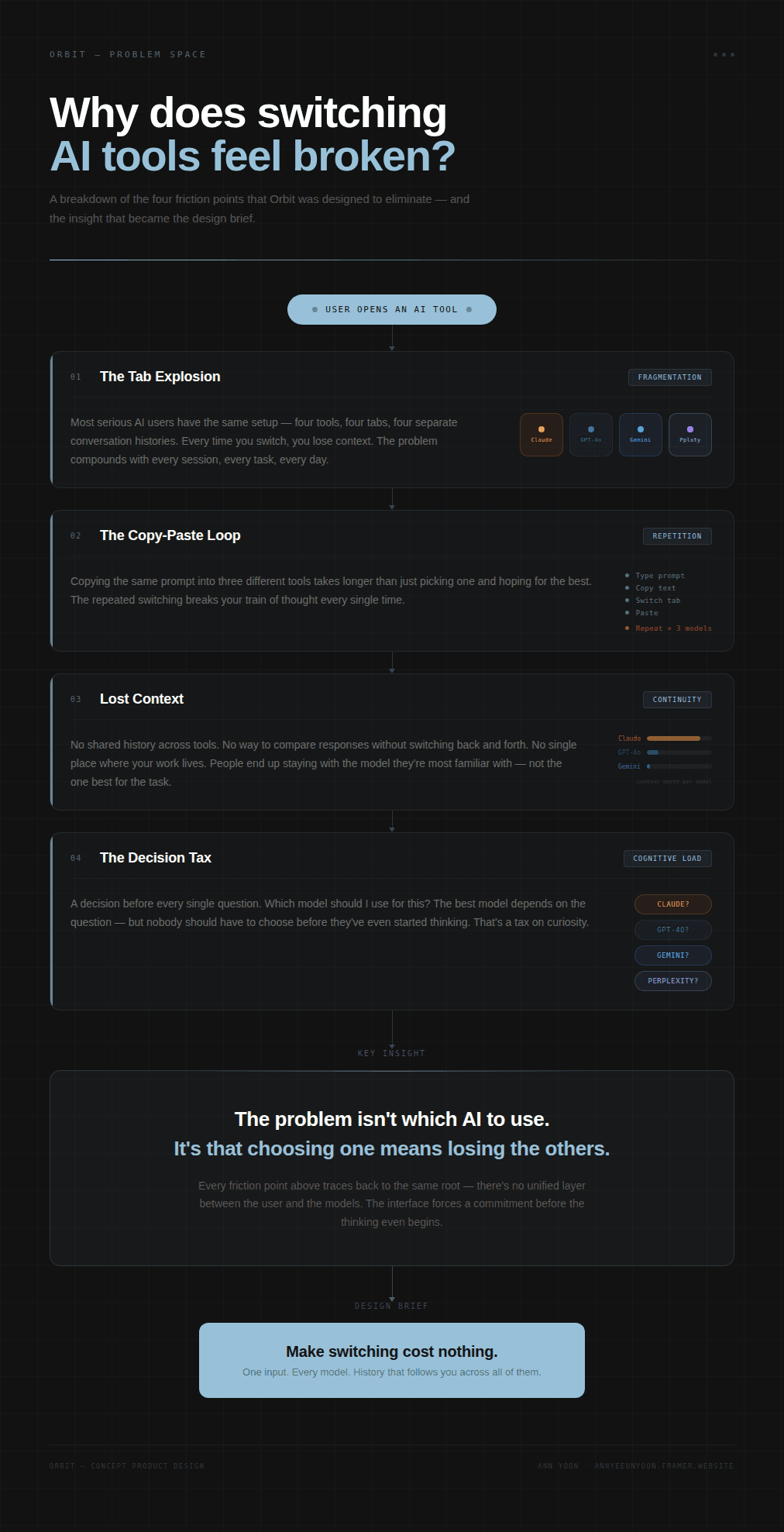
The friction isn't using AI — it's managing it. Opening a new tab breaks your train of thought. Copying the same prompt into three tools takes longer than just picking one and hoping for the best.
There's no shared history across tools, no way to compare responses without manually switching back and forth, and no single place where your work lives. People end up choosing the model they're most familiar with, not the one that's actually best for the task.
↓ Problem Flow Chart
The friction isn't using AI — it's managing it. Opening a new tab breaks your train of thought. Copying the same prompt into three tools takes longer than just picking one and hoping for the best.
There's no shared history across tools, no way to compare responses without manually switching back and forth, and no single place where your work lives. People end up choosing the model they're most familiar with, not the one that's actually best for the task.
↓ Problem Flow Chart
The friction isn't using AI — it's managing it. Opening a new tab breaks your train of thought. Copying the same prompt into three tools takes longer than just picking one and hoping for the best.
There's no shared history across tools, no way to compare responses without manually switching back and forth, and no single place where your work lives. People end up choosing the model they're most familiar with, not the one that's actually best for the task.
↓ Problem Flow Chart
(02)
Problem
Problem
(02)
Problem
(03)
Process
Process
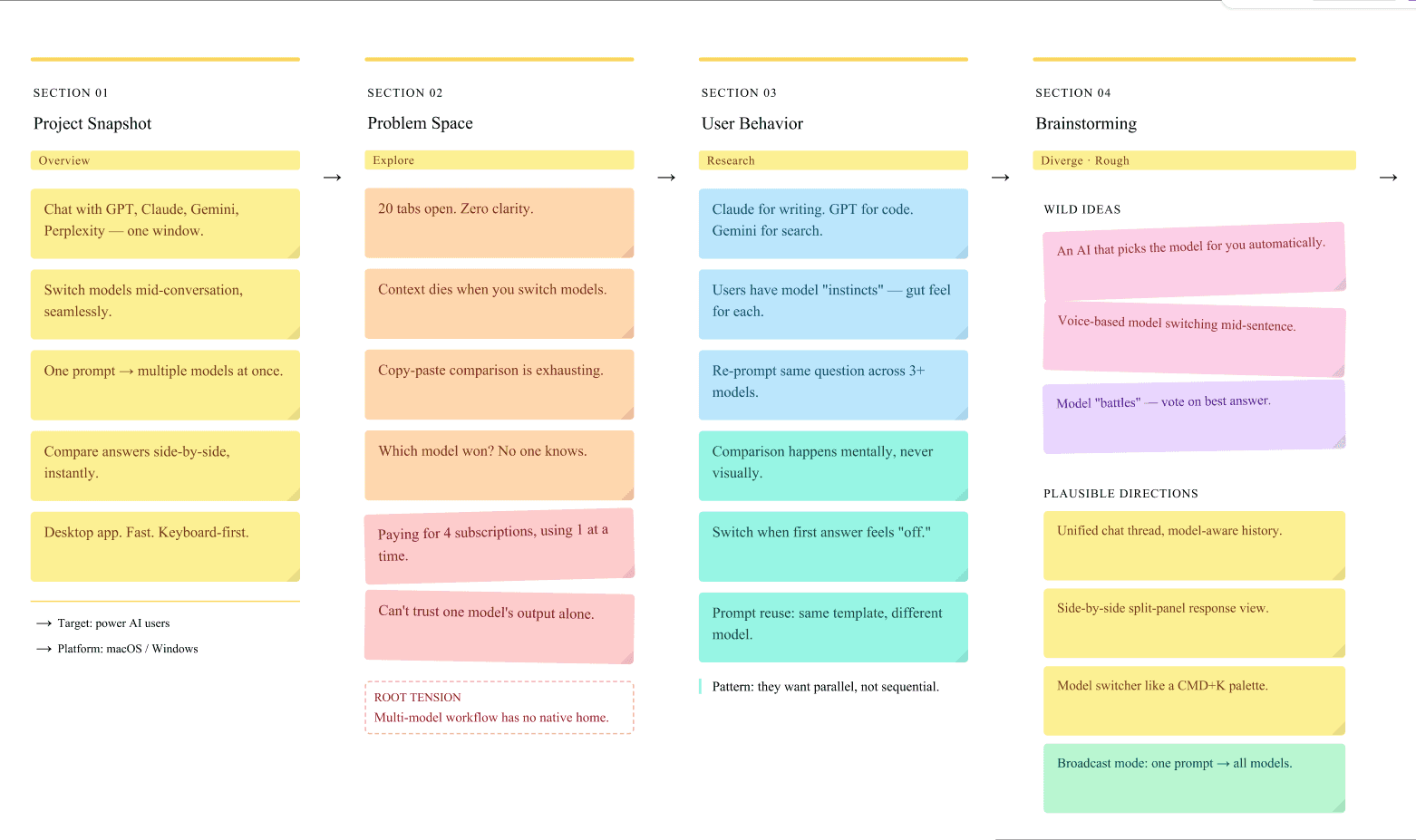
I spent two weeks using ChatGPT, Claude, Gemini, and Perplexity simultaneously for the same tasks.
I tracked every moment I switched between them and why.
The pattern was consistent — it was never because one model was clearly better.
It was because I didn't know which one to trust for that specific question, and switching was too disruptive to do freely.
That became the design brief: make switching cost nothing.
One persistent input, one model switcher, conversation history that follows you across models.
I spent two weeks using ChatGPT, Claude, Gemini, and Perplexity simultaneously for the same tasks.
I tracked every moment I switched between them and why.
The pattern was consistent — it was never because one model was clearly better.
It was because I didn't know which one to trust for that specific question, and switching was too disruptive to do freely.
That became the design brief: make switching cost nothing.
One persistent input, one model switcher, conversation history that follows you across models.
(03)
Process
I spent two weeks using ChatGPT, Claude, Gemini, and Perplexity simultaneously for the same tasks.
I tracked every moment I switched between them and why.
The pattern was consistent — it was never because one model was clearly better.
It was because I didn't know which one to trust for that specific question, and switching was too disruptive to do freely.
That became the design brief: make switching cost nothing.
One persistent input, one model switcher, conversation history that follows you across models.
(04)
(04)
Solution
Solution
Solution
Orbit gives you one input bar connected to every model you use. In chat mode, you pick a model and have a normal conversation — but you can switch to a different model mid-thread with one click, and the history stays intact. In compare mode, you write one prompt and get three responses side by side, each labeled with the model's name and response time. Every model has a consistent color across the entire interface — Claude is always orange, GPT is always green, Gemini is always blue — so you can scan responses without reading the labels.
Orbit gives you one input bar connected to every model you use. In chat mode, you pick a model and have a normal conversation — but you can switch to a different model mid-thread with one click, and the history stays intact. In compare mode, you write one prompt and get three responses side by side, each labeled with the model's name and response time. Every model has a consistent color across the entire interface — Claude is always orange, GPT is always green, Gemini is always blue — so you can scan responses without reading the labels.
Orbit gives you one input bar connected to every model you use. In chat mode, you pick a model and have a normal conversation — but you can switch to a different model mid-thread with one click, and the history stays intact. In compare mode, you write one prompt and get three responses side by side, each labeled with the model's name and response time. Every model has a consistent color across the entire interface — Claude is always orange, GPT is always green, Gemini is always blue — so you can scan responses without reading the labels.
OTHER PROJECTS

OTHER PROJECTS